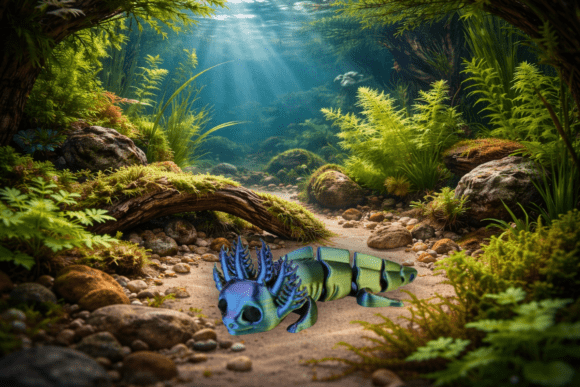
Cute Flexi Axolotl STL Articulated 3D Print Model: A Modern Desktop Companion
In an era where digital fatigue is becoming a common professional complaint, the desire to reconnect with tangible, tactile objects has surged. This shift in consumer behavior and personal workflow preferences has given rise to a new category of desk accessories: articulated 3D printed figures. Among these, the Cute Flexi Axolotl STL Articulated 3D Print Model stands out as a perfect blend of whimsy, functionality, and technical craftsmanship. It is not merely a static figurine; it is a dynamic object designed to move, interact, and bring a sense of calm to busy environments.
The axolotl, often called the "Mexican walking fish," has long been a symbol of resilience and regeneration in nature. In the world of 3D printing, this creature has become an icon of the hobbyist community, celebrated for its unique gills and perpetual smile. The evolution from rigid statues to flexible, articulated models like the Cute Flexi Axolotl - Articulated 3D Print Model with Customizable Fin Separate Eyes reflects a broader trend in maker culture: the demand for objects that are both visually appealing and mechanically engaging.
The Rise of Tactile Technology in Modern Workspaces
For professionals aged 20 to 50, the modern workspace is increasingly dominated by screens, keyboards, and virtual meetings. While technology streamlines productivity, it often strips away the sensory variety that helps maintain focus and reduce stress. This is where articulated fidget toys enter the conversation. Unlike digital distractions, physical objects like the Flexi Axolotl provide a low-stakes outlet for nervous energy without pulling attention away from the task at hand.
The design philosophy behind the Cute Flexi Axolotl STL Articulated 3D Print Model aligns perfectly with current ergonomic and psychological trends. The model features flexible body segments that allow for smooth, fluid movement. When placed on a desk, it serves as a subtle companion that can be manipulated during moments of deep thought or creative block. This interaction mimics the benefits of traditional fidget tools but elevates them through aesthetic appeal and customization options.
Furthermore, the "print-in-place" capability of this model demonstrates how 3D printing technology has matured. Users no longer need to assemble dozens of loose parts with complex tolerances. Instead, the body prints as a cohesive unit, ready to flex immediately after support removal. This efficiency appeals to busy entrepreneurs and freelancers who value high-quality results without excessive time investment.
Customization as a Creative Workflow
One of the most compelling aspects of the Cute Flexi Axolotl - Articulated 3D Print Model with Customizable Fin Separate Eyes is its modular design approach. In a market saturated with mass-produced goods, the ability to personalize an object offers a deeper sense of ownership and satisfaction. The customizable dorsal fin allows creators to experiment with color theory directly on their desktop.
Imagine printing the main body in a soft pastel shade while swapping the fin for a vibrant neon or metallic finish. This technique, known as a multi-color swap, turns a simple print job into a mini-design project. For marketers and designers, this process can serve as a practical exercise in visual hierarchy and contrast. It encourages users to think about how different materials and colors interact under office lighting.
The separate eyes add another layer of depth to the customization experience. By printing the eyes independently and gluing them into place, the model gains a three-dimensional quality that flat prints cannot achieve. This small assembly step transforms the object from a toy into a collectible figure. It invites the user to slow down and engage in the creation process, fostering a mindful pause in an otherwise rushed day.
Material Choices That Enhance Organic Forms
The choice of filament plays a crucial role in bringing the Cute Flexi Axolotl STL Articulated 3D Print Model to life. Standard PLA works well, but the organic curves and flowing details of the axolotl are best showcased using specialized filaments. Materials like PLA Silk, Magic Silk, Rainbow, or Galaxy filaments react uniquely to light, creating a shimmering effect that mimics the iridescence of real aquatic life.
Using PLA Silk, for instance, can make the segmented body appear smoother and more continuous, enhancing the illusion of a living creature. The reflective properties of these materials catch the light as the axolotl moves, adding a dynamic visual element to the workspace. This attention to material science highlights how 3D printing has evolved from a prototyping tool into a medium for fine art and decorative design.
For those looking to create a specific mood, the combination of a dark Galaxy filament for the body and a bright accent color for the fin can create a striking contrast. Conversely, a monochromatic print using different shades of silk PLA can offer a sophisticated, minimalist look suitable for corporate environments. These options demonstrate the versatility of the model across various aesthetic preferences and professional settings.
Practical Assembly and Printing Guidelines
While the design is beginner-friendly, achieving the best results requires adherence to specific printing parameters. Understanding these technical requirements ensures that the final product functions as intended—flexing smoothly without breaking or binding. The Cute Flexi Axolotl - Articulated 3D Print Model with Customizable Fin Separate Eyes is engineered to work within standard FDM printer capabilities, making it accessible to a wide range of users.
Recommended Print Settings:
- Layer Height: Aim for a range between 0.08 mm and 0.16 mm. Thinner layers (0.08–0.12 mm) are ideal for capturing the fine details of the gills and facial features, while slightly thicker layers (0.14–0.16 mm) can speed up the process without significantly compromising the flex mechanism.
- Supports: Supports are necessary due to the overhangs created by the articulated joints and the dorsal fin. Ensure your slicer software is configured to generate tree supports or standard supports that are easy to remove without damaging the delicate joints.
- Brim: While optional, adding a brim can improve bed adhesion, especially if printing with shiny filaments like PLA Silk which sometimes struggle with initial layer adhesion.
- Infill: An infill density of 10% to 15% is sufficient. Since the model relies on the structural integrity of the walls for flexibility, excessive infill is unnecessary and may hinder the smooth movement of the segments.
- Material: PLA and PLA Silk are the recommended materials. Avoid flexible filaments like TPU for the main body unless you have advanced experience, as the design relies on the rigidity of PLA combined with the geometry of the joints to create the flex effect.
Assembly Notes:
Once the print is complete, the assembly process is straightforward but requires care. The eyes must be printed separately to ensure they fit snugly into the eye sockets. Use a small amount of super glue or cyanoacrylate adhesive to attach them. This step is critical for achieving the expressive look that defines the character. Additionally, if you choose to print the dorsal fin in a different color, ensure it is fully cured before inserting it into the slot on the back of the axolotl. A gentle press-fit usually holds it securely, but a drop of glue can provide extra stability for long-term use.
Why Collectors and Professionals Are Choosing Articulated Models
The popularity of the Cute Flexi Axolotl STL Articulated 3D Print Model extends beyond simple novelty. It represents a convergence of several cultural and technological shifts. As remote work becomes a permanent fixture for many, individuals are curating their home offices to reflect their personalities and values. A static statue does little to break the monotony of a video call background, but a moving, colorful axolotl adds character and conversation-starting potential.
Moreover, the educational aspect of this model cannot be overlooked. For educators and parents introducing children to STEM concepts, the axolotl serves as an excellent example of mechanical engineering principles. The way the segments interlock to allow movement while maintaining structural integrity is a practical lesson in kinematics. It demystifies the concept of "articulation" in a fun, accessible way.
From a business perspective, offering such models as branded merchandise or gifts can leave a lasting impression. A customized Flexi Axolotl with a company logo or brand colors serves as a memorable takeaway that recipients are likely to keep and display. It bridges the gap between utility and sentiment, functioning as both a fidget toy and a piece of art.
Integrating the Model into Your Routine
To get the most out of your Cute Flexi Axolotl - Articulated 3D Print Model with Customizable Fin Separate Eyes, consider how it fits into your daily rhythm. Place it near your keyboard for easy access during stressful calls. Use the act of bending and twisting its body as a micro-break to reset your focus. The repetitive motion can be surprisingly meditative, helping to ground your thoughts when anxiety spikes.
Whether you are a seasoned 3D printing enthusiast or a newcomer exploring the hobby, this model offers a rewarding experience. It challenges you to refine your slicing skills, experiment with materials, and appreciate the intersection of biology and design. As the technology continues to evolve, models like this will likely become even more sophisticated, offering new ways to interact with our physical environment.
Ultimately, the Cute Flexi Axolotl STL Articulated 3D Print Model is more than just a file download; it is an invitation to slow down, create, and enjoy the small pleasures of the tangible world. In a landscape defined by rapid change and digital abstraction, having something cute, flexible, and entirely yours to customize provides a comforting anchor.